Short answer
Purity describes composition. Yield describes recovery relative to a defined starting amount. Check which material and process step each number refers to, then request evidence for the actual ingredient being offered. A patent does not establish this supplier’s production route, lot quality or rights to a process.
Inspect the evidence and limits →Use this guide to
- Identify what is measured and the starting amount behind each percentage.
- Connect each patent result to the stated process step and experiment.
- Ask how the quoted ingredient, production route and lot records are connected.
1. Define purity and yield before comparing numbers
For a quoted ingredient, first define which constituent is being measured and what the denominator represents. A purity result may be expressed per mass of dry material; an analytical report may instead use another convention. Ask the laboratory or supplier to state the basis rather than interpreting an unlabeled percentage.
| Term | Buyer’s question | Needed evidence |
|---|---|---|
| Purity or assay | What fraction of this defined sample is the named constituent? | Method, unit, reporting basis and lot result |
| Step recovery | How much named constituent leaves one operation compared with what entered it? | Defined input/output and mass balance |
| Overall yield | Which starting material and process boundary are used? | Consistent basis across the whole calculation |
| Patent evidence | What process or composition does the document actually describe? | Publication, claims, examples and their limits |
Do not rank a raw material’s quality by putting an assay and a process recovery into the same comparison column. A quote needs a defined technical specification even when the supplier also provides process information.
2. Read the reported experiment in context
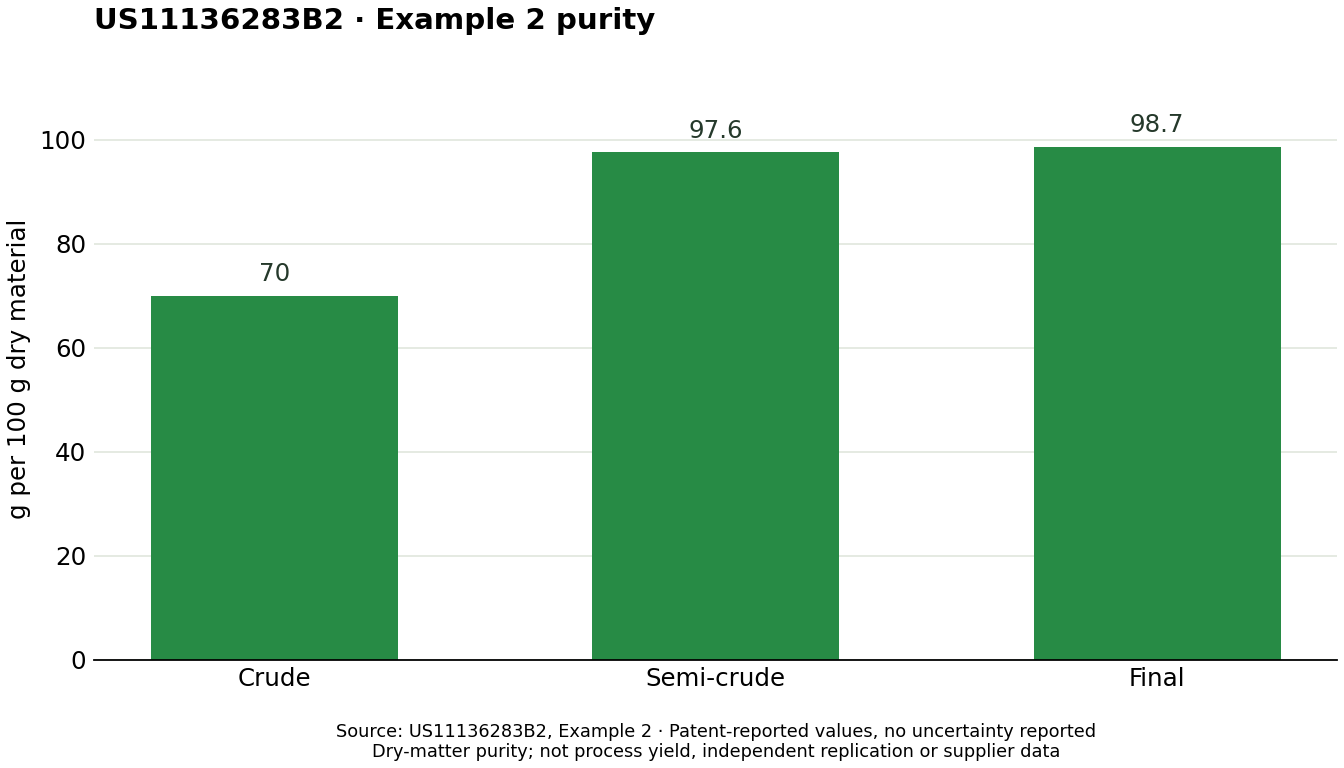
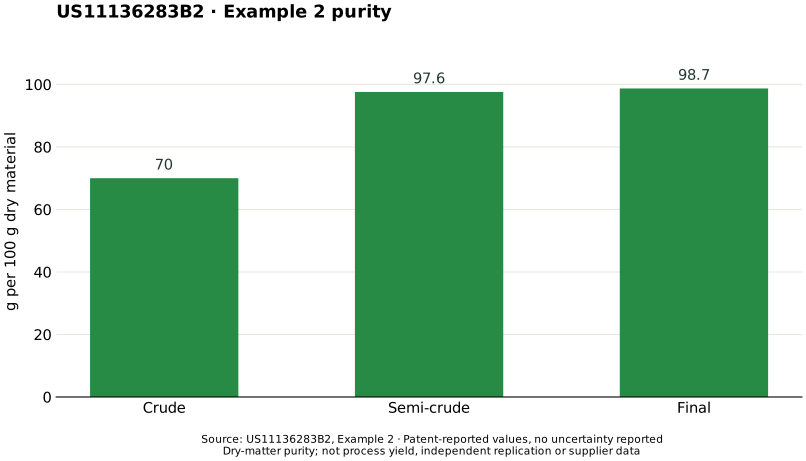
US11136283B2 describes recovering resveratrol from microbial fermentation. Example 2 reports selected dry-matter purity values of 70, 97.6 and 98.7 g per 100 g at successive material stages. The chart shows those reported values, not independent replication. No uncertainty estimates are supplied for this comparison.
Read the numeric source values and units
| Reported item | Value | Unit |
|---|---|---|
| Crude | 70 | g resveratrol per 100 g dry material |
| Semi-crude | 97.6 | g resveratrol per 100 g dry material |
| Final | 98.7 | g resveratrol per 100 g dry material |
These values describe the cited external material or study, not a Yisheng Maolian lot. See the figure caption and original source for interpretation and limits.
The same example reports an overall downstream yield of 73%. That number has a different denominator from the purity values and is intentionally excluded from the purity plot. The example concerns a fermentation route; it does not describe the origin or manufacturing process of our listed material.
Example 2 also reports 97.6% for recovery of resveratrol from the semi-crude material during the final operation. The repeated number has a different denominator from the semi-crude purity of 97.6 g per 100 g dry sample.
| Reported figure | Denominator | What it describes |
|---|---|---|
| 97.6 g per 100 g | Dry semi-crude sample mass | Constituent purity |
| 97.6% | Resveratrol entering the final purification operation in the semi-crude material | Reported step recovery |
| 73% | The example’s overall downstream process boundary | Reported overall yield |
Record the material, operation and denominator beside each figure. Equal numbers do not make these measurements interchangeable.
3. Confirm the route of the actual offered material
When a supplier sends a patent link, ask why it is relevant to your purchase. Is the document background reading, a description of an asserted manufacturing route, or a claimed intellectual-property relationship? Record the answer and request the appropriate evidence for that specific assertion.
Separately establish the source of the offered ingredient, its composition and the quality records that accompany it. Do not infer botanical extraction or fermentation from the compound name or a white-powder image. A third-party patent cannot connect a sample to a manufacturing location or lot record by itself.
Intellectual-property permission and freedom to operate require their own professional assessment. This guide does not determine patent validity, current legal status, infringement or licensing rights.
4. Request a comparable specification package
- Identify the named constituent and whether a specific isomer is part of the specification.
- Request the assay method and basis, together with the relevant lot COA.
- Ask for complete composition, carriers and source-route information relevant to the project.
- Define impurity and residual-solvent questions with your quality team according to the offered process and intended use.
- Link the evaluation sample to its documentation and the proposed sale lot.
For commercial comparison, keep quotation validity, quantity, packaging and delivery terms beside the agreed specification. If process data are included, place them in a separate evidence field so they cannot be mistaken for a current lot-release result.
5. Check the actual trans-resveratrol listing
The trans-resveratrol material in our source catalogue lists a 98% specification and an HPLC method label. Those are source-listing statements that still require the selected grade’s written specification and current documents. The patent figures above do not validate that listing or predict its process yield.
Use the COA review checklist to record unanswered questions, document versions and the reviewer’s decision. Request clarification before treating unrelated process literature as supplier qualification.
Methodology & limitations
A focused reading of US11136283B2, Example 2, including the paragraphs adjacent to Table 4 and Figure 3. The plot transcribes three reported dry-matter purity values; no error bars, participant data or new experiments were generated. A patent is a technical disclosure and its examples are not independent replication or Yisheng Maolian testing. Process-route, health-performance and intellectual-property claims are not inferred for our products. Initial source capture: October 24, 2026; latest recorded source check: October 26, 2026. Technical review pending. The second reported 97.6% is presented separately as step recovery, not plotted as a purity result.
Sources
- US11136283B2, Recovering and purifying resveratrol produced by microbial fermentation, Example 2 / Table 4 / Figure 3
- Patent-reported chart values and source locations (download JSON)
Compare the defined commercial materials
External patent data do not verify the manufacturing route or yield of either listed material.