Short answer
Keep extraction ratio, marker content and price in separate fields. Define the ratio, identify the assayed compound and establish a common reporting basis before calculating marker cost. A more precise calculation cannot make different materials equivalent.
Inspect the evidence and limits →Use this guide to
- Record the extraction ratio separately from a named-marker result.
- Compare composition and assay basis before placing quotations in the same cost model.
- Use the calculator only after recording its assumptions; it provides arithmetic, not a dose.
1. Ask what the extract ratio describes
When a supplier offers a 10:1 extract, ask for the definition behind the notation. Which starting material is being counted? What is the moisture basis? Does the finished mass mean native extract or a commercial powder containing a carrier? Without these answers, two identical ratio labels may describe different accounting boundaries.
Even a clearly defined material ratio does not, by itself, establish the amount of a chosen marker. Nor does it demonstrate absorption, a clinical outcome or superiority over a lower ratio. If your formula requires a marker target, request its assay rather than inferring it from the ratio.
This distinction matters when a purchasing spreadsheet sorts quotations by a single ‘strength’ column. Create separate fields for the ratio definition, botanical source, carrier and marker assay. Preserve information that cannot yet be normalized instead of forcing it into an assumed common scale.
2. Specify the marker and the basis of the result
A standardized extract brief should name the analyte or defined group, its target range, analytical method and unit. Clarify whether the result is reported as supplied or calculated on a dry basis. Ask how the carrier and any other ingredients appear in the composition statement.
For an illustration, 10% of one compound cannot be compared with 10% of a different compound by percentage alone. Similarly, a group assay and an individual-compound assay may address different measurement targets. Your quality team should assess method suitability before procurement treats those values as interchangeable.
The US dietary supplement component-specification framework in 21 CFR 111.70 is useful background: ingredient acceptance needs defined specifications, rather than an undefined notion of ‘strength’. The exact specification package depends on the material and use.
3. Check that an assay is supported by measurement
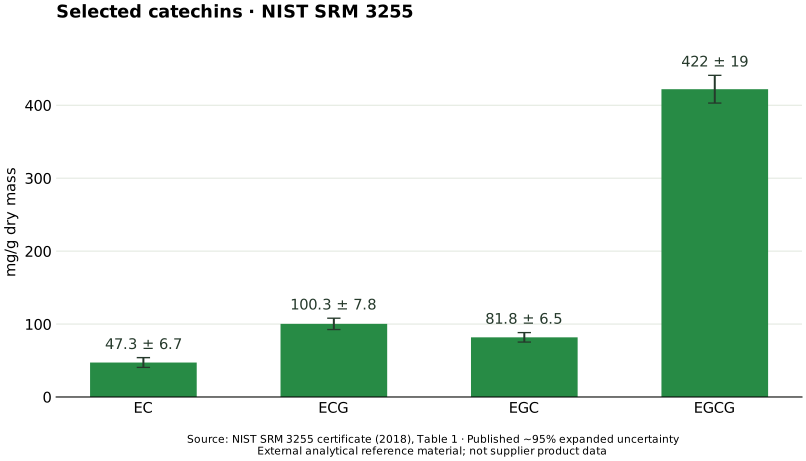
An input/output ratio is not a laboratory result for a named constituent. The published development of green tea standard reference materials provides an analytical example: specified constituents are characterized in defined matrices, using documented measurement work. It is background for asking how an assay is supported; it does not test the hypothetical ratios or calculations in this guide.
Before normalizing prices, ask which material is being weighed, whether carriers are included and what basis applies to the assay. If those definitions differ, a precise calculation can still produce an unsuitable commercial comparison. Record the unresolved assumption rather than filling it with a percentage from another material.
4. Calculate marker mass with explicit assumptions
If an ingredient contains a stated marker percentage by mass on an as-supplied basis, a simple calculation is possible: ingredient mass × assay percentage ÷ 100 = marker mass. In the chart below, a hypothetical 500 mg ingredient portion gives 5 mg at 1%, 25 mg at 5%, 50 mg at 10% and 100 mg at 20%.
These values are arithmetic examples, not laboratory results, product specifications or recommended human doses. They assume an exact mass fraction, no processing loss and a consistent basis. An actual batch must be evaluated using its own records and measurement uncertainty.
Marker-mass calculator
Arithmetic aid only. No potency, suitability, bioavailability or dosage recommendation is implied.
5. Compare price only after the technical match
For genuinely comparable grades, cost per gram of a marker can help explain a quote. At a hypothetical $40 per kilogram and 10% marker by mass, one kilogram contains 100 g of marker, giving $0.40 per gram of marker before freight, duties, testing, losses and other costs. This is a purchasing calculation—not a quote from Yisheng Maolian.
The formula cannot make unlike ingredients equivalent. A cost model that ignores identity, contaminant specifications, carrier, processing behavior or stability may favor a material that cannot be used. Put technical acceptance before the financial calculation and maintain a separate landed-cost sheet.
| Compare first | Then calculate |
|---|---|
| Same analyte and comparable method | Marker mass on a common basis |
| Accepted identity and quality specifications | Price per accepted quantity |
| Equivalent composition and application suitability | Landed cost including testing and handling |
6. Send six questions with your next quote request
- What species, plant part and source material does the product represent?
- What exactly is the ratio definition, including native extract and carrier?
- Which marker is assayed, by what method and on what basis?
- Which composition and quality records accompany the offered lot?
- What form and handling conditions suit the intended manufacturing process?
- What quantity, packaging, delivery terms and quote validity are offered?
Use the answers to decide whether quotes belong in the same comparison. If they do not, ask the supplier for an alternative grade or revise the technical brief. That produces a more useful buying decision than ranking every ratio and percentage on a single numerical scale.
For a catalogue example, the Quillaja saponaria extract record carries a source-listed 10:1 label. That label does not quantify saponins. Ask for the ratio definition and any required saponin assay as separate records before comparing an offered grade.
Methodology & limitations
The graph, calculator and cost example use explicitly hypothetical inputs and elementary mass-fraction arithmetic. No supplier specifications, clinical doses or experimental observations are implied. The regulatory link supplies context for defining specifications, not a universal extract-ratio standard. Technical review is pending.
Sources
- 21 CFR 111.70 — Component and product specifications
- Calculation dataset and assumptions (download JSON)
- Sander et al., Development and certification of green tea-containing standard reference materials — analytical context, not validation of the hypothetical ratio
- PubMed PMID 22127575 — analytical-method publication record and abstract
Select the appropriate comparison route
Start with botanical identity when the preparation is not marker-defined, or compare a named marker and assay basis.