Short answer
Specify the analyte or defined constituent group, the method, units and mass basis. EGCG is one named catechin, not a substitute term for every group result. The NIST example shows how measurements are reported; the offered ingredient needs its own specification and lot records.
Inspect the evidence and limits →Use this guide to
- Name EGCG, a defined catechin group or another measurement target explicitly.
- Check whether quotations use the same units, mass basis and analytical definition.
- Specify the lot records needed for the material you will receive.
1. Compare the same measurement
Begin with the actual grade you intend to buy. Write the botanical source and plant part, the physical form, the constituent or group being quantified and the complete composition. If a quotation names polyphenols but the sample document names EGCG, ask whether these are separate results or competing descriptions of one specification.
| Quotation term | Clarify before comparison | Record in the brief |
|---|---|---|
| EGCG | The named analyte and its reporting basis | Assay, method reference and units |
| Total catechins | Which compounds are included in the total | Constituent list and calculation rule |
| Polyphenols | The definition and analytical procedure used | Method-specific result; no assumed conversion to EGCG |
| Extract ratio | The input/output and carrier basis | Record separately from the analyte assay |
Do not select a grade by treating these terms as interchangeable. A clear comparison sheet should have a separate column for each result that matters to the formulation. When a value is absent, request it rather than filling it from another supplier’s material.
2. Inspect a real example of analytical reporting
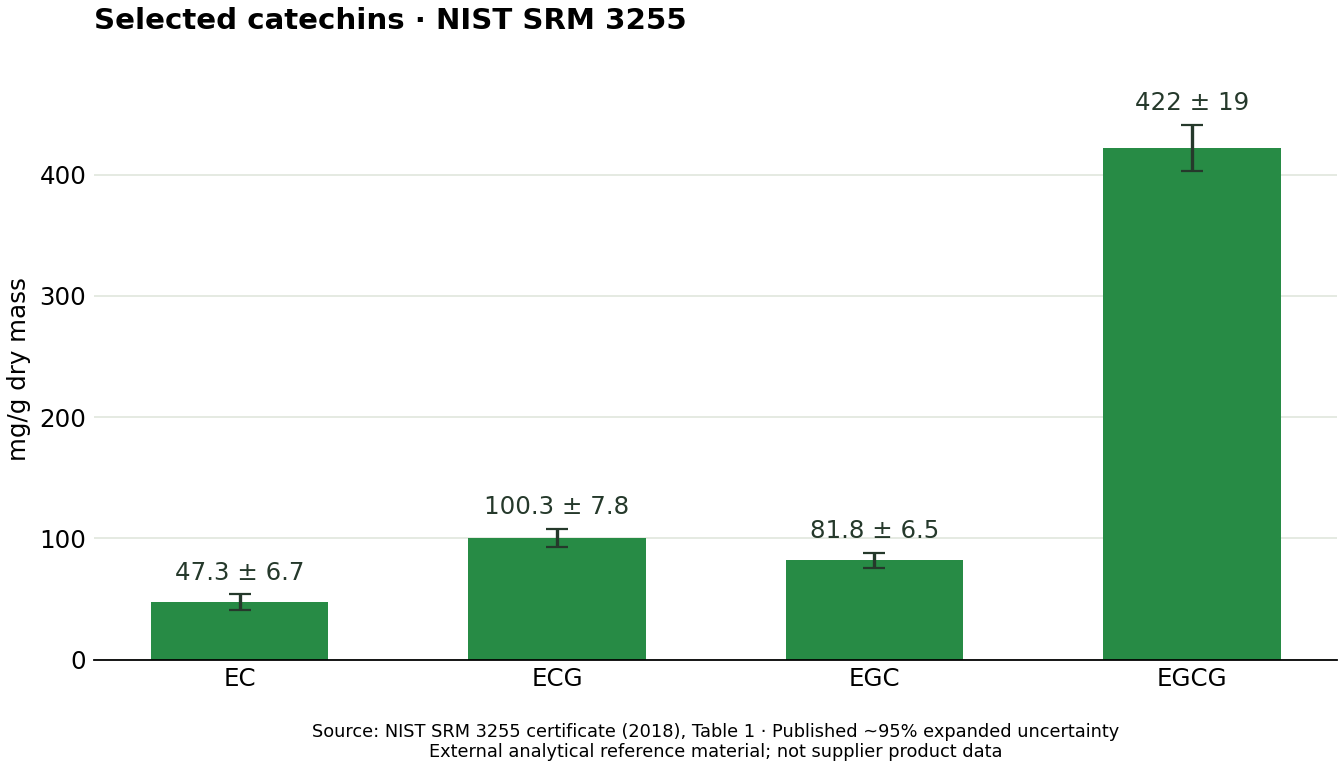
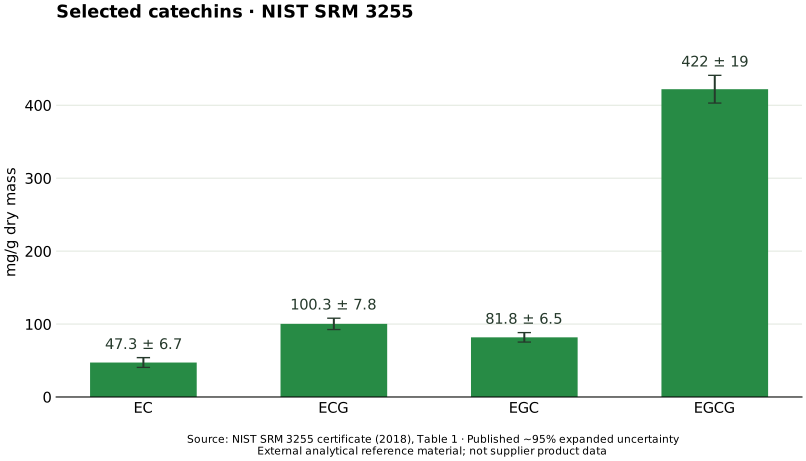
NIST SRM 3255 is a green tea extract reference material for analytical work. Its February 2018 certificate reports the four selected catechin values below in mg/g on a dry-mass basis. The whiskers retain the certificate’s expanded uncertainties at approximately 95% confidence. These are reference-material values, not a commercial grade target or Yisheng Maolian batch results. The certificate identifies the material for analytical research, not human consumption. Inspect Table 1 on PDF page 4.
Read the numeric source values and units
| Reported item | Value | Unit | Published expanded uncertainty |
|---|---|---|---|
| epicatechin | 47.3 | mg/g dry mass | ± 6.7 mg/g; approximately 95% confidence |
| epicatechin gallate | 100.3 | mg/g dry mass | ± 7.8 mg/g; approximately 95% confidence |
| epigallocatechin | 81.8 | mg/g dry mass | ± 6.5 mg/g; approximately 95% confidence |
| epigallocatechin gallate | 422 | mg/g dry mass | ± 19 mg/g; approximately 95% confidence |
These values describe the cited external material or study, not a Yisheng Maolian lot. See the figure caption and original source for interpretation and limits.
The accompanying Sander et al. analytical publication describes development of the reference materials using multiple analytical approaches. This supports a useful procurement question: how does the laboratory establish that its result is appropriate for the particular extract matrix?
The PubMed publication record and abstract provide a second route to identify the analytical-method paper.
3. Keep the denominator visible
Record whether the result describes the material as supplied or a dry-mass basis. Keep the moisture result and its method alongside the assay if a conversion is needed. The buyer and testing laboratory should agree on the calculation and whether measurement uncertainty affects the acceptance decision.
Likewise, distinguish milligrams per gram of powder from milligrams per serving of a finished product. A formulation input, a filled capsule and a reference material have different identities. Matching a number on paper does not establish that those materials are equivalent.
Use the ratio and marker-mass guide for arithmetic examples. Its calculations are illustrative and remain separate from the measured reference-material data shown here.
4. Send a grade-specific document request
- Ask for the current technical specification, named analytes and full composition.
- Request the offered lot’s COA or clarify how a representative COA relates to it.
- Ask which method and reference materials support the assay, with relevant validation information.
- Specify whether caffeine, carriers or other constituents need separate limits for your project.
- Describe the intended formulation system, sample quantity, purchase quantity and destination.
Keep each answer connected to a document version and a sample or lot. Your quality team can then compare the offered material against an agreed specification instead of evaluating an isolated marketing percentage.
5. Review the actual green tea listing
Our source listing for green tea extract contains different specification fields, including an unexplained numerical field. The website flags these differences. They are not presented here as a confirmed EGCG grade.
For an enquiry, state the constituent you need measured and request the corresponding written specification, method and sample documentation. The external research in this guide does not resolve those listing differences or verify the offered material.
Methodology & limitations
Focused purchasing guide, not a systematic review or a laboratory investigation. Four selected values and their published expanded uncertainties were transcribed from Table 1, PDF page 4, of the NIST SRM 3255 certificate issued February 9, 2018. No values were inferred for a Yisheng Maolian material. The plot omits other certificate constituents and must not be read as a complete composition. Source checked October 26, 2026; technical review pending.
Sources
- NIST SRM 3255 certificate, issued February 9, 2018, Table 1, PDF page 4
- Sander et al., Development and certification of green tea-containing standard reference materials, DOI 10.1007/s00216-011-5472-7
- NIST publication record and analytical-method summary
- PubMed PMID 22127575 — analytical-method publication record and abstract
Apply the measurement distinction
The listed material uses polyphenol wording; this guide does not establish that it is an EGCG-standardized grade.