Short answer
Match the document to the offered lot and agreed specification. Check methods, units, limits and actual results, then record missing or conflicting information for quality review. A supplier COA does not replace the buyer’s applicable testing and qualification obligations.
Inspect the evidence and limits →Use this guide to
- Match the quoted material, specification version, sample and lot.
- Read each result together with its method, unit and acceptance limit.
- Record missing or conflicting fields for the receiving quality reviewer.
1. Connect the COA to the quoted material
Begin with document identity. Record the ingredient name, manufacturer or issuing party, lot number, document date and the version of the specification being applied. Check that the quote and sample refer to the same material. If a sample is representative rather than taken from the sale lot, write that distinction into the evaluation record.
Commercial names alone can conceal differences in plant part, carrier, extraction system or standardization. Ask for the technical specification alongside the COA. If one says ‘root extract’ and the other only ‘plant extract’, do not assume they are equivalent. A clear document trail should let a receiving team connect the delivered labels, purchase order and release records without reconstructing the transaction from emails.
2. Separate identity from marker strength
For US dietary supplement manufacturing, 21 CFR 111.70 addresses component specifications, including identity and relevant quality characteristics and contamination limits. Section 111.75 generally requires at least one appropriate identity test or examination for dietary ingredients before use, subject to the specified exemption process. Reliance on supplier COAs for applicable other specifications involves supplier qualification and additional conditions. Read §111.75.
A marker assay and botanical identity testing answer different questions. Ask your quality team which evidence is appropriate for the processed material. Do not label one technique universally sufficient for every botanical, extraction process or matrix.
3. Read every result with its method, unit and limit
A number without a unit cannot support a reliable comparison. A number without a method can hide a difference in what was measured. A ‘Pass’ result needs an identified specification and a basis for the decision. Review these items as a set rather than isolated cells.
| Field | Question to resolve | Useful follow-up |
|---|---|---|
| Identity | What material is confirmed? | Species, plant part and appropriate examination |
| Assay | What compound or group is measured? | Method, unit and as-is/dry basis |
| Contaminants | What was tested against which limit? | Actual results and relevant reporting thresholds |
| Microbiology | Which organisms or counts were assessed? | Method, unit and acceptance criteria |
| Traceability | Does this record match the offered lot? | Lot label and manufacturing/document references |
As an example of interpretation rather than a product specification, ‘below reporting limit’ and ‘not tested’ are different statements. An empty field should not silently become a zero. If two laboratories use different units or reporting limits, normalize only after the underlying methods and definitions are understood.
4. Read an external analytical record correctly
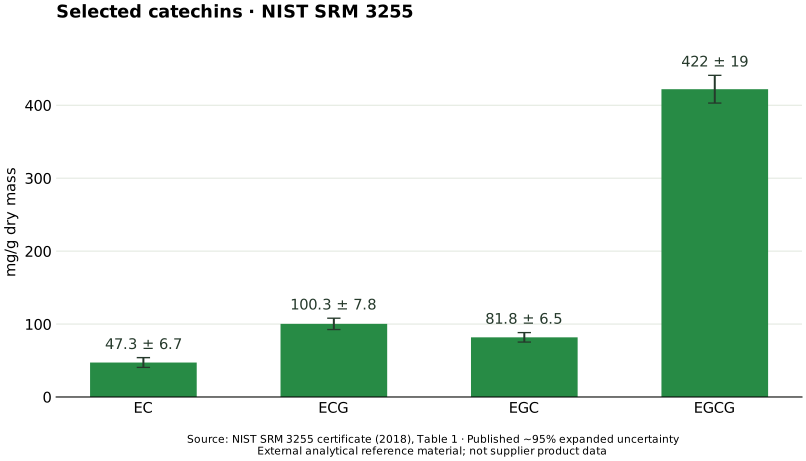
As an external reading example, the NIST SRM 3255 certificate, Table 1 reports EGCG at 422 ± 19 mg/g on a dry-mass basis. The uncertainty is an expanded uncertainty at approximately 95% confidence. The certificate concerns an analytical research material that is not intended for human consumption; it is not a supplier lot COA and does not approve our green tea listing.
| Read together | Why the buyer needs it |
|---|---|
| Named analyte + result + unit | Establish what the reported number measures. |
| Dry-mass basis + uncertainty statement | Keep the denominator and interpretation visible. |
| Material identity + source document | Prevent a reference material’s value being assigned to an unrelated ingredient. |
A buyer should request the corresponding definitions for the actual offered lot. Do not copy a reference value into an empty supplier result cell. The green tea assay guide explains the external dataset and provides its plot and downloads.
5. Use a repeatable review workflow
The workflow above is an editorial checklist, not a regulatory scoring system or an audit certification. Avoid giving a supplier an automatic approval simply because every box contains text. The adequacy of the evidence depends on the material and intended use.
Keep a short discrepancy log. For each question, record the requested clarification, the supplier response, the supporting document and the reviewer’s disposition. This is particularly useful when a supplier revises a method, changes manufacturing location or offers a substitute grade between sampling and ordering.
6. Prepare the document request and purchasing handoff
A practical initial request includes the offered specification, representative COA with its lot relationship, botanical and plant-part information, full composition and storage guidance. Ask about additional documents according to the application and your quality program rather than sending an indiscriminate list of every certificate name.
For supplier COA reliance under §111.75(a)(2)(ii), the rule includes establishing reliability, keeping qualification documentation, periodic reconfirmation and quality-control review. Build your purchasing handoff so those decisions remain visible. Your own quality and regulatory teams should determine which requirements apply to the finished business activity.
Attach the agreed specification to the commercial order. That gives price, quantity and delivery terms a defined technical object. If a critical item remains unresolved, make the outstanding condition explicit before placing the order.
Methodology & limitations
Practical editorial workflow based on the cited US dietary supplement manufacturing provisions. The table and diagram are decision aids, not experimental results, legal advice or a representation of Yisheng Maolian certification. Application depends on the business activity and material. Technical review is pending.
Sources
- 21 CFR 111.70 — What specifications must you establish?
- 21 CFR 111.75 — What must you do to determine whether specifications are met?
- NIST SRM 3255 certificate, Table 1 — external analytical-record reading example
Turn the review into a document request
The article explains how to read a record; the document guide and worksheet help prepare a specific request.